Rocket Lab — Neutron
Neutron is a medium-lift, partially reusable rocket under development by
Rocket Lab — the company already operating the highly successful small-lift Electron launcher.
Neutron is designed to deliver 13,000 kg to low Earth orbit and targets the booming
megaconstellation market.
Key features include a methane/liquid oxygen propulsion system, a carbon-composite structure,
and Rocket Lab's distinctive "Hungry Hippo" fairing — a captive fairing that
opens to deploy the payload and then closes again, returning to Earth with the first stage
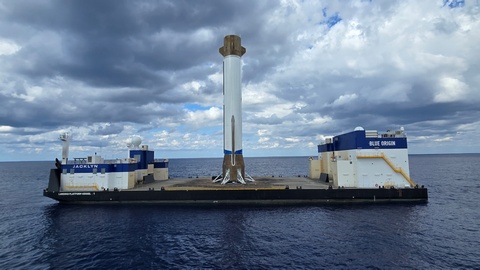
rather than being discarded. The first stage will land on a dedicated barge named
Return on Investment.
After completing structural qualification tests, engine validation at NASA Stennis, and
construction of Launch Complex 3 in Virginia, Neutron is targeting its maiden flight
in late 2026. Rocket Lab plans to scale to three launches in 2027 and five in 2028.
Neutron already holds contracts for commercial megaconstellation launches and has been selected
for NASA's VADR launch services program and the U.S. Space Force Rocket Cargo evaluation.
Stoke Space — Nova
The most radical entry in the field, Nova by Washington-based startup
Stoke Space aims to be fully reusable from day one — both first and second
stages. While SpaceX is working toward full Starship reusability incrementally, Stoke is
designing it in from the ground up.
Nova's second stage features a ring of 24 thrust chambers surrounding a
regeneratively cooled heat shield — a liquid-cooled metallic shield that
eliminates the need for fragile thermal tiles, enabling the upper stage to survive re-entry
and land propulsively. The first stage uses seven full-flow staged combustion methalox
engines.
Backed by over $1.3 billion in funding (including an $860 million Series D),
Stoke is refurbishing historic Launch Complex 14 at Cape Canaveral — the same pad that
launched John Glenn into orbit in 1962. Nova is targeting a first orbital flight
attempt in late 2026, with a payload capacity of 5 tonnes to LEO. If successful,
it would be the first rocket ever designed for full reusability of both stages from its
very first flight.
China's Reusable Rocket Surge
Perhaps the most striking development in the reusable rocket race is the sheer number of
Chinese companies pursuing Falcon 9-class vehicles simultaneously. A decade after China's
commercial space sector barely existed, multiple companies are now racing to master powered
booster landings:
LandSpace — Zhuque-3
The furthest along of the Chinese entrants. Zhuque-3 (named after the
vermilion bird of Chinese mythology) is a methane-fueled rocket capable of lifting 18,300 kg
to LEO in reusable mode — comparable to Falcon 9. On its maiden flight in December 2025,
the payload reached orbit successfully, but the first-stage booster experienced a combustion
anomaly during the final landing phase and crashed near the target. LandSpace is planning
a second flight and landing attempt for mid-2026, with ambitions to refly a recovered
booster by late 2026 and eventually launch weekly at costs as low as $7.6 million per
flight.
CASC — Long March 12A
Not to be outdone by the private sector, China's state-owned CASC (China Aerospace Science
and Technology Corporation) is building its own reusable rocket. The Long March
12A is a methalox vehicle nearly identical in size to Zhuque-3 (69 m tall, 3.8 m
diameter). It launched to orbit on its maiden flight on December 23, 2025 — just weeks
after Zhuque-3 — and like its commercial rival, successfully delivered its payload but
failed to land the first-stage booster. With both the state and private industry pursuing
parallel reusability programs, China is attacking the problem from multiple angles
simultaneously.
iSpace — Hyperbola-3
Beijing-based iSpace is developing Hyperbola-3, another methane-fueled
reusable rocket. The company is targeting its maiden orbital flight with a first-stage
splashdown recovery, followed by a booster refly by mid-2026. iSpace is building out engine
test facilities and expanding production capacity to twenty rockets per year.
Galactic Energy — Pallas-1
Galactic Energy, already operating the expendable Ceres-1 small-lift rocket,
is developing Pallas-1 — a partially reusable vehicle designed to carry
8,000 kg to LEO. The rocket is in advanced assembly with a debut flight approaching.
And More
Several other Chinese firms — including Deep Blue Aerospace (Nebula-1), Space Pioneer
(Tianlong-3), OrienSpace (Gravity-2), and CAS Space (Kinetica-2) — are all targeting debut
flights of reusable or reusability-capable rockets during 2025-2026.
A Global Reusable Future
The launch industry is undergoing a fundamental shift. Within a few years, multiple countries
will have operational reusable rockets from multiple providers. Competition drives down
costs, increases launch frequency, and opens space to more customers — from satellite
operators and scientific missions to national security and eventually tourism.
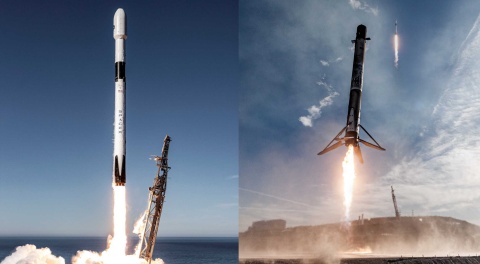
What SpaceX pioneered with Falcon 9 is becoming an industry standard. The question is no
longer whether rockets will be reusable, but how many reusable rockets
the market can support — and how fast the cost of reaching orbit will fall.